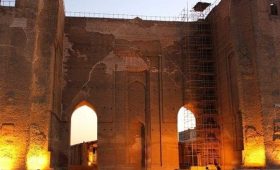

The city of Shush (Susa), located in Khuzestan province, is one of the oldest known origins in the world, where humans have lived. Susa’s charm is due to the ancient and historical monuments in this city.
Susa is one of the most magnificent and beautiful ancient cities of Iran and the world and is one of the most important centers of world civilization and is one of the most famous cities of Iran and the world. Few people are tourists and historians and do not know the ancient city of Susa. In ancient Iran, Susa was a city and a great center for governments. The city of Susa dates back to about 4,000 BC. Susa has been the capital of the Elamite government and civilization for thousands of years. It was also the winter capital of the Achaemenids. The historical site of Shousha was registered in 2015
Geographical location of Susa
The city of Shush has an area of about five square kilometers and is located 115 kilometers northwest of Ahvaz. The distance of the city of Shush from the sea level is about 78 meters and it is 115 kilometers away from Ahvaz. The distance from Susa to the Tigris River is about 150 km. The geographical location of Susa was such that it was the meeting point of the two great civilizations of Elam and Mesopotamia. This caused Susa to find a significant position in the ancient history of Iran. The weather in Shousha is hot and dry due to its location in the south of Iran, and in summer its temperature is very high and humid. The geographical location of Susa has led most of the people of the city to choose trade and agriculture. The existence of three rivers, Karkheh, Dez and Shavar, has caused agriculture and fishing in this city.
Historical history of Susa
The city of Susa is mentioned in various historical sources. Susa and Suziana and Sushan are the names mentioned for Susa. According to Hamzeh Esfahani in her book, Shush means a beautiful and peaceful city. Susa was the center of Elmaite rule from 2700 BC. The Elmaite rule in the city of Susa dates back to about 2,000 years. Many inscriptions and bricks have been obtained from this city that prove the prosperity and civilization of the city. Most of the work on the inscriptions and inscriptions of Susa has been done by Professor Abdolmajid Arfai. The subject of the obtained brick inscriptions mostly indicates the origin and installation of the people, and in the temples, the brick inscriptions were about the gods and their letters. The topics related to the inscriptions were mostly economic issues such as buying and selling land, wills, etc. Remains of Susa during the Elmaite period show that women in this city had a social status equal to that of men, and documents show the signatures and seals of women in trade.
Susa, due to its special geographical position and being located between the two civilizations of Elam and Mesopotamia in the north of the Persian Gulf, achieved a significant position in the Achaemenid period and was considered as a crossroads of west and east. Susa had a special strategic position and its location on the royal road in the period of Darius multiplied the position and fame of Susa.
Although the city of Susa dates back to 4000 BC, excavations in this area show that Susa was also inhabited by farmers in 9000 BC, and the remains of castles have been found in Susa, which show that they lived in this area about 5000 years ago. There has been a trend, but the history of Susa’s fame goes back to the Elmaite period. Susa has its greatest fame from the Achaemenid period, but in the Parthian and Sassanid periods it retained some importance but was not as prosperous as the Achaemenid period.
The Elmaite had a fortress in Susa, but due to the Assyrian invasion of the city of Susa and its destruction, all the relics of the city were destroyed and razed to the ground. Darius later rebuilt the city and built the palace of Apadana in Susa.
For the first time during the Qajar period, the French were able to obtain a drilling permit in Susa from Nasser al-Din Shah. Excavations were allowed, but during the same excavations, many of Susa’s antiquities were taken out of the country and taken to France. During the reign of Muzaffar al-Din Shah, a new contract was signed in this regard, and for a period of sixty years, the French were given the privilege of drilling in Susa. Finally, in the early days of Reza Shah Pahlavi, the contract was declared illegal.
The ancient attractions of Susa
The royal road, built during the Achaemenid period by order of Darius the Great, connected the city of Susa, the political capital of the Achaemenid state, with Pasargadae, Persepolis, and other cities of the empire, including the cold city of Lady. It can be said that the management of the vast land of Iran and maintaining its security and rapid transfer of military units and the expansion of trade and transportation and facilitation of travel have been the most important factors in the construction and expansion of the road network in this period.
The castle of Susa was built by Demorgan near the tomb of the prophet Daniel. Many artifacts have been recovered from this hill, one of which is the statue of Queen Napirasu. In the construction of this castle, the bricks of Darius Apadana Palace have been used.
The Museum of Susa is located in the middle of the garden on the way to the ancient castle of Susa and in front of the tomb of Daniel the Prophet. The original building of the museum was made at the same time as the beginning of the glass excavations and using the bricks obtained from the glass excavations and the Choghaznabil excavations, and parts were added to it during the following years. The Shusha Museum was opened in 1975. The works of this museum belong to the previous period from Elam to the Islamic period. The Shousha Museum has six large halls, and all the works on display are the result of excavations in the Shousha and Choghaznabil areas.
Apadana Palace in Susa was the winter palace of Darius, which was also used by other Achaemenid kings. The walls of the palace are made of clay and the columns are made of stone. The palace had a hall, a shrine, a gate and a reception palace. The inner walls of the palace have paintings with the theme of the winged lion, the lotus and the eternal army.
Ardashir Palace is in the western part of the Shavar River. The palace has a hall measuring six by five meters and has 64 columns. This palace is 350 meters away from Apadana and was built by Ardashir II of the Achaemenid dynasty.
Karkheh porch is a city from the Sassanid period and belongs to Shapur II. This city is 20 km from Susa. A huge rampart surrounds the palace grounds and gates are located on each side. This area is the largest buried Sassanid city.
Haft Tappeh is an ancient site that is 15 km away from Susa and different hills are formed. Excavations on this hill and the existence of many skeletons have shown that there was a large tomb on this hill.
Natural attractions
Karkheh River in Khuzestan province passes by the ancient monuments of Shousha city and shows a beautiful picture of Shousha city. Karkheh River Bridge, Dehloran-Shousha, on the Dehloran Road, north of the New Iron Bridge. This staircase is related to the works of Ivan Karkheh and has tourism values.
Shush Park, also known as the wind park, has a green space at the entrance of the city that has been prepared for the well-being of tourists and the people of Shush.
Another area is a natural attraction of the city of Susa. This area has dense shrubs and bushes. Animals such as reptiles, mammals, birds and amphibians live in this area.
Religious attractions
The tomb of the prophet Daniel is located east of the Shavor River. The tomb has two courtyards, around which there is a room and a porch. The tomb is located at the end of the second courtyard. The courtyard has three rooms for pilgrims. The roof of the yard is made of mirrors and has skylights on the eight corners under the dome.
Shousha Mosque is one of the important monuments of Shousha city, which is a columnar nave with a central courtyard and an external fence, and has walls made of cream brick. The qibla of the mosque is a columned hall. Inscriptions are carved from brick and in Kufic script on the southeastern margin of its courtyard. In the eastern corner of the mosque, the remains of a minaret with a spiral staircase have been discovered. It is said that the mosque dates back to the first century AH.
Another Islamic monument of the city is the tomb of Dabal Khazaei, who was a poet.