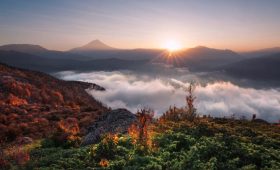

Oramanat is the name of a region in the Oraman section of Sarvabad city in the west of Kurdistan province and is limited to Iraq from the west and Kermanshah province from the south, and a 75 km long road connects it to Marivan.
This region is a common part between Iran and Iraq and has a winding plain with beautiful and various rivers, that is very beautiful. The famous springs of this region are Sirvan and Leila. The two rivers meet near Iraq and are called Darula. The houses of the city are generally made of stone and are built in the form of arches and steps, that is why Oraman is also called the village of Hezar Masouleh.
Oramanat consists of two parts, small and large. A small part of the city of Halabja is part of Iraq and a large part is one of the provinces of Kermanshah and Kurdistan of Iran. Oraman Takht village is the center of Oraman district and most of its people have settled in cities such as Tehran, Marivan, Sanandaj, Halabja, Javanrood, Kamyaran, Ravansar and Kermanshah. This historic village originally consisted of three parts called Horaman Takht, Xavuro and Lahun.
What is the meaning of Oramanat?
Oraman is also called Horaman. Of course, this village is called “Hooraman” in the local language. Oraman or Oraman-Takht consists of two parts, Hora and Man. Many believe that Hura was Ahura. In this way, Ahuraman means the house of Ahuramazda, and if we take Horaman from the Avestan Hor in the meaning of the sun and we know it in the meaning of the house, it means the house and the place of the sun.
The people of Oraman believe which in the past Oraman was one of the largest cities in the region and had a central government; They consider the naming of Oraman as the Throne of Oraman as a parallel to the proof of this belief and believe that this means that Oraman had a throne of government and was considered the center of government. In recent years, archaeological excavations have been carried out in the Oraman region, dating back 6,000 years to the Copper Age. There is an inscription in Oraman which belongs to Assyria and this can be another proof of the antiquity of the region. Some believe which the history of Oraman’s urban center dates back to the Sassanid period.
The customs and letters which are in this area show that it is ancient. But the fact that the city must be related to the Sassanid period requires accurate documents that are not currently documented in this regard.
History of Oramanat village
According to surviving evidence, near the villages of Nav, Hajij and Spree lived people with an estimated history of about 40,000 years, dating back to the Paleolithic period. From this historical period, the tools of cavemen, the remains of stoves and some bones that look like the skeleton of a mountain goat have been found in the caves of Merv and Gilan. Neanderthal human bones have also been discovered in the Shanider and Biston caves, that are said to be more than 40,000 years old. Over time, people migrate to this village, the remains of that have been found in a cave called Kanache.
It is interesting to note that researchers have found evidence near the village of Roar, including a large stone tomb with a domed roof and a number of houses, showing that humans lived in the Iron Age in this area and their history is estimated to be more than 3,000 years old. These findings are considered as the most historical works of this region and its architecture is related to the western part of Zagros. Because it was designed and built in the dry form of China, and also near the village of Tangivar, an inscription has been found that seems to be a relic from the Assyrian era. Images of the Assyrian ruler named “Sargon II” are engraved on this inscription and also a cuneiform inscription was found that after being translated by experts, refers to the subject of the Assyrian ruler’s attacks on Oraman and Zagros.
Archaeologists have found a number of animal skins in the village that they believe date back to the Parthian and Seleucid eras and were engraved in Pahlavi and Greek. All these historical statistics were inside a container that a person named Dr. Saeed Kurdistani is said to give to the British and they keep these valuable objects in their country’s museum. It seems that at that time, people wrote their sales documents on the skins of animals, and these skins were originally the document of the land sale transaction between two people, and the names of the people who were present in the transaction were written on them as witnesses. Researchers date the skin to about 120 BC.
Climate and vegetation of Oramanat
The climate of the Oraman region is mountainous. This area has many springs and pastures. In the foothills of the Oraman Mountains, there are beautiful gardens that have made animal husbandry, along with gardening, the main occupation of the people of the city.
Numerous animal and plant species are observed in this area. Oak trees, wild pistachios, walnuts and figs are among the trees of this region and rhubarb, artichoke, sorrel, etc. are also among the vegetation of this region.
In addition to being mountainous, this beautiful land has large and lush forests, and trees such as oak, hawthorn and wild pear have grown in these forests and have doubled the beauty of this region. It seems that the people of this region have used the wood of these forests to heat their houses and cook food since ancient times.
Oramanat people
Oraman Takht was originally a village, but in recent years with 540 families and a population of 2800 people in 1390 became the center of the district. The people of the Oraman region speak the Orami language, that is one of the Gorani dialects and is a subset of the dialects of northwestern Iran. The people of Oraman are Muslims and their religion is Sunni. However, in this region, the mirrors related to ancient Iran are common and have been preserved in the historical memory of the people.
The people of Oraman have their own Kurdish folk costumes. The Kurdish men of this region wear Chukheh, Pantol, Maleki Shawl, Dastar, Faranji and Kalhebal, and the women of Jani wear Klanjeh, Kolnjeh, Shawl, Kolah and Kalleh. These clothes are decorated with ornaments and have special colors. The handicrafts of Oraman are kilims, rugs, felt, quilts, wooden utensils, etc.
Architecture of Oramanat village
The stepped architecture of Oraman Takht and its spectacular houses have shaped the village into a pyramid, at the top of that is an ancient castle. The stepped architecture of these houses has made it known as the village of Hezar Masouleh, and it is in such a way that the yard of each house is behind the roof of other houses. The architecture of Oramanat and the greenery of this dreamy mountainous region seem to depict steps towards heaven.
Pirshalyar ceremony in Oramanat
Oraman Takht, in addition to having natural attractions and attractive architecture, has special spiritual attractions such as summer alleys and the annual Pir Shaliar annual ceremony. The people of Oraman come to this ceremony in special Kurdish clothes and hold mystical music and special ceremonies for cooking ash and so on. It is said that Pir Shaliar was one of the elders of Oraman region who was engaged in promoting Islam in this region and people hold two ceremonies in his honor every year in two seasons of the year.
What attract attention in this ceremony are the customs and traditions that can be seen in this celebration. In these customs, the roots of Zoroastrian and ancient beliefs can be seen, that shows the historical antiquity of Oraman and the special ancient customs of this region remain in the historical minds of the people. Some also consider this ceremony to be related to the ancient customs of the people, that were later tied to Islamic beliefs. The tomb of Pir Shaliar, who was a follower of Abdul Qader Gilani, is located at the end of the Oraman asphalt road. The ritual includes slaughtering the sacrificial animal, playing the daf, dancing, eating ash, and spending the night reciting poetry and prayers.
Sights of Oramanat
Sirvan River, that flows in the southwest of Kurdistan province, after receiving water from the southwestern, western and central parts of the province, such as Gheshlagh, Gavrood and Gardalan, becomes Sirvan. The main part of this river flows in Sarvabad city and the ancient region of Oraman and then enters the Great Tigris River in Iraq after joining the Diyala River. In fact, this river is the longest river in Kurdistan province. The banks of this river are very beautiful and its bed and sides are home to a variety of birds and fish that are very useful in terms of recreational and tourist exploitation.
The best way to see the grandeur and beauty of Sirvan is the distance between the villages of Spreez and Hajij, that due to the location of the sandy road along the river, has important and extremely valuable visual stations for leisure, photography and imaging. Due to its roaring, this river is also a place for training and domestic and foreign sailing competitions.