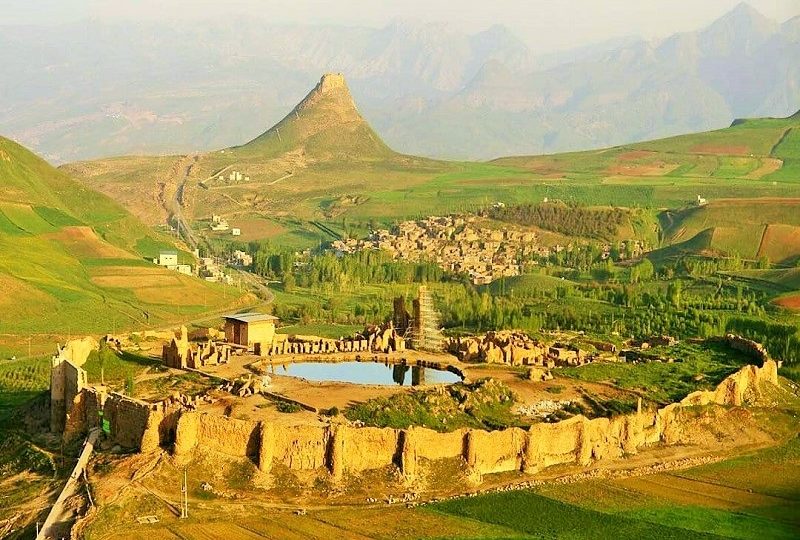
The ancient city of Takht-e Soleyman was inhabited by the Medes, Achaemenids, Parthians, Sassanids and Mongols, who were at the height of their prosperity and power during all these periods. Takht-e Soleyman dates back to three thousand years and its eternal fire for seven centuries was a sign of the greatness and authority of the Sassanid rule and Zoroastrianism. In fact, this region was the largest center of religious education and training of Zoroastrian priests in the Sassanid era. This collection was included in the list of national monuments of Iran on December 20, 1316 and was registered in the world in July 2003 to be the fourth work of Iran in the UNESCO World Heritage List after Persepolis, Choghaznabil and Naghsh Jahan Square.
The Takht-e Soleyman , along with its ancient and natural wonders, is one of the places on the planet where the flow of the earth’s energy is well understood. Tourists come to this place on the peak day of the earth’s energy activities and turn clockwise around the lake to experience an amazing spiritual feeling.
Takht-e Soleyman is located 45 km northeast of the city of Takab in the southeast of West Azerbaijan Province.
History of the Takht-e Soleyman
The buildings in the Takht-e-Soleyman complex were built in different historical periods, namely the Parthian, Sassanid and Ilkhanid periods, the most important of which are the fire temples and halls of the Sassanid period; however, in archeological excavations, traces of the Achaemenid and material periods have also been found in this place.
Artifacts from the Takht-e Soleyman show the 3,000 years of human habitation in this place. These works, in addition to belonging to the Paleolithic period, Iron Age I, II and III, include signs of the settlement of the people in the Scythian, Manichaean, Median, Achaemenid and Parthian periods in the Takht-e Soleyman. The remains of inhabited villages in the northwest of the lake is one of these cases, which according to research is related to the Achaemenid period.
It is said that the construction of the Takht-e Soleyman and its fire temple was given by Bahram Gour, one of the Sassanid kings; however, other Sassanid kings were involved in its prosperity and development. Until this place was destroyed in 624 AD by the Roman Empire. After the destruction of the Sassanid rule and the acceptance of Islam in Iran, the huge complex of Takht-e Soleyman was no longer revived.
After Islam, the priests of this ancient site agreed with the conquering general of Azerbaijan not to destroy the fire temple in exchange for taxes, and therefore this fire temple survived until 400 years later. During the Seljuk period, many Zoroastrians were forced to emigrate and took the sacred fire of Mars to the Persians of India. In the aftermath of this story, ordinary people first set foot in this sacred area, where they lived a seasonal and urban life.
With the rise of the Mongol ilkhans, this place was used as the summer and summer capital of the kings, which is evidenced by the existence of 700-year-old buildings. During the reign of the Mongols called the Aga Khan in the seventh century AH, various buildings such as the eastern porch, council hall, octagonal and 12-sided buildings were added to the Takht-e Soleyman complex.
After the fall of the patriarchal government, Takht-e Soleyman was used as a seasonal village and bazaar and became a nomadic summer settlement during the Safavid period. Finally, it was 250 years ago which the Takht-e Soleyman was permanently deserted and gradually many stories and legends were formed about it, that according to one of these beliefs, this place was attributed to the Prophet Solomon (PBUH) and therefore less looted Was located and later protected.
The Takht-e Soleyman site was discovered in 1819 by Sir Robert Corporter, and Sir Henry Rawlinson gave a detailed description of the site during a visit in 1838.
In 1937, an American photographer named Schmidt took photographs of Solomon’s throne, imagining it to be a military barracks; However, he later realizes the historical value of its fence. Finally, famous archaeologists such as von Draston, Kleis, etc. discovered the secrets of this world heritage by exploring the Takht-e Soleyman between 1337 and 1357.
After the Islamic Revolution, no excavations were carried out in this place until 1372; until this year, its restoration operations were resumed and finally in 2003, it was registered in the UNESCO World Heritage List. In 2016, the University of Dresden, Germany, resumed its cooperation with Iran for a five-year exploration period.
Takht-e-Soleyman Lake
In the area of Takht-e-Soleyman, you will encounter a beautiful view of a natural lake, the water of which boils from a spring 120 meters below the ground, and because it has a lot of salts and lime, it is not suitable for drinking. In addition, “no swimming” signs have been placed around the lake so which tourists are not deceived by its beautiful appearance and do not commit suicide.
This boiling and calcareous spring is thousands of years old and is an important reason for the construction of the Takht-e Soleyman in this place. Takht-e Soleyman spring is considered to be one of the main chakras of energy on earth and some believe that visiting it can help improve the physical and mental condition of people. According to Gaia, the earth has a living and conscious soul, and according to this, 16 rings of energy, like nerves with a magnetic charge, surround the earth. The intersection of these rings has led to the formation of 52 chakras or cycles, three of which are the pyramids of Egypt, the Kaaba and the Takht-e Soleyman .
Wonders of Takht-e-Soleyman Lake
There are various narrations about how the spring of Takht-e-Soleyman Lake boils, and we will mention two of them in the following.
Breaking the staff of Solomon: According to this belief, the prophet Solomon strikes his staff on the ground and right at the place where the staff touches the ground, springs boil which turn into a lake over time.
Bags of soil by Hazrat Maryam (AS): It is said that Hormozd, the Persian king, after hearing the news of the birth of Jesus (AS), sends a messenger to congratulate Hazrat Maryam (AS). He gives the messenger bags of dirt; but before he reached his destination, he fell ill at the place of Solomon’s throne, and before he died, he buried the bag in the same place. Upon learning of this, the king ordered a number of buildings to be erected there, at the same time as a spring gushed from the ground, causing it to flourish.
Many legends have been told about the existence of treasure in the depths of the lake; However, in no historical period has there been a word about the discovery of these treasures. The great depth of the lake and the sediments suspended in the water have been an obstacle for the explorers to discover the truth of the story. For the first time, German divers entered the lake; however, sediments and pressure in the water did not allow them to find anything in the lake.
The Treasure of Cyrus the Great: The oldest story about the treasure dates back to the time of Cyrus the Great. Accordingly, when Cyrus defeated Croesus, king of Lydia, the treasury dumped his valuables in the water of the Holy Lake.
Takht-e Soleyman ‘s Castle: According to another legend, in 36 BC, at the time of the Roman-Parthian wars, Takht-e Soleyman was besieged by Antonio. The guards of the Holy Fire Temple, in order to prevent the precious objects of the castle from falling into the hands of the enemy and to be safe from them, vowed these objects to the lake and the water god and dumped them in the Holy Lake. Zoroastrians believe that Lake Takht-e-Soleyman belongs to Anahita (the goddess of water) and that making vows was common there. It is said that in 624 AD, when Khosro Parviz and the Eastern Romans were at war with each other; Priors poured the vows and treasures of the fire temple into the lake before the complete capture of Takht-e-Soleyman fortress. In addition, it is possible that treasures were dumped into the lake during the Iranian-Arab wars in early Islam.
Ring of Hazrat Suleiman (AS) : According to some beliefs, Hazrat Suleiman made this castle with his magical ring with supernatural powers. Legend has it that the devil threw the Prophet’s ring into the lake and sat on the throne with a similar appearance. Some say that this ring was buried forever in the lake, and others say that a fish ate the ring and Solomon found it in the belly of the fish, thus regaining its power.
Grail: Grail is the holy cup of Jesus Christ (PBUH) that he drank just the night before his death. Some people believe that this cup is in the Takht-e Soleyman ; However, no trace of it has been found so far.
Takht-e Soleyman Prison
There are many beliefs about the Takht-e Soleyman , one of the most famous of which is related to the prison mountain. A hollow conical mountain called the mountain of the prison of the demon or the prison of Solomon near the Takht-e Soleyman , which according to some beliefs, this mountain was a place for the prison of the demons of the prophet Solomon (AS) who were trapped in a deep pit. The locals believe that Prophet Sulayman (AS) threw them into this black hole to punish the disobedient demons. It seems that one of these demons was the same demon who stole the Prophet’s ring.
This conical mountain, which reaches a height of 97 to 107 meters from the adjacent lands, was formed thousands of years ago due to the deposition of water minerals in the lake, and there is a pit 80 meters deep in the middle with an opening diameter of about 65 meters. The mountain was used as a place of worship during the Manichaean period between 830 and 660 BC, and there are numerous sulfur hot springs with healing properties around it.
Takht-e Soleyman prison was a place of worship for Zoroastrian priests and victims during the Sassanid era; After the prayers, the priests took the sacrificial animal to a special place for the vow of the fire temple.
The middle cone of this mountain, apparently, about two thousand years ago, like the present-day Lake Takht-e-Soleyman, was full of water and was located at the mouth of the hill; But over time, due to the increase in the volume of sediments, its cracks at a depth of 100 meters are closed and the cone dries. Based on their observations of the mountain and its surroundings, the scientists concluded that small springs formed the cause of such a high mountain.
Dio Prison or Suleiman Prison is the first natural monument of West Azerbaijan, which was registered in the list of national monuments.
Different parts of the Takht-e Soleyman
The complex of Takht-e-Soleyman historical buildings is built around a beautiful lake, which is surrounded by an oval fence and wall. Inside this fence, there are two squares, which are located in the center of the north square of the fire temple and in the center of the south square of the lake. In addition, in the northwest of the lake, a high porch called Ivan Khosrow can be seen, and in the southwestern part outside Takht-e Soleyman, there is a rocky atmosphere called “Dragon Stone”, which is about 1.5 to 2 meters high and 250 meters. It has a length. In the following, we will provide a brief description of the different parts of the Takht-e Soleyman .
The elliptical fence of Takht-e Soleyman, 1120 meters long, has 38 towers, which acted as a defensive fence for the complex. This fence was rebuilt in different periods; However, due to the passage of time and human injuries, only the gates of the southeast, part of the fortifications, etc. remain. Takht-e-Soleyman fence In addition to the north gate which was the main entrance of the city and the southeast gate which is the safest gate left from Takht-e-Soleyman, in the patriarchal era had a gate in its southern part which today leads to highways and is the entrance to visit the complex. .
At the entrance of the southeast gate, there are seven stone altars as a sign of the seven guardian gods in Zoroastrianism, and people entered the complex under this sacred sign.
Azargashnesb Fire Temple
The peak of the power of Takht-e Soleyman belongs to the Sassanid period, and it was at this time that one of the three most important fire temples of this era, called the Fire Temple of Azargoshensap, was built in this place, which is also called Azargoshasp and Azarshsap. The importance of this fire temple was so great that each of the Sassanid kings, after sitting on the throne, went to visit it on foot and offered a share of war booty to the fire temple.
In fact, the original name of this complex is the Fire Temple of Azargeshnsp, which is mistakenly called the Takht-e Soleyman ; Because during the Arab invasion of Iran, in order to protect this place from harm, they attributed stories of the Prophet Suleiman to it.
In difficult days, the Sassanid kings visited Azargashnsp and vowed their gold, wire and property. This fire temple was also known as “Azarkhosh”; In fact, Azar in the language of ancient Iran means “fire” and good means “good”. The fire temple was a sign of unity and solidarity of the central government with the religion of Zoroaster and was considered a symbol of the Sassanid government.
According to Abu Delf, the fire temple of Azargashnesb was self-burning or ever-burning and had no ashes due to working with gas and oil. Hormozdiar’s narrations also confirm this issue. However, scientific research shows that the priests kept the fire burning with the fragrant and sacred trees of the fire temple courtyard and sent its ashes to other parts of the Sassanid realm as a blessing.
The importance of Azargashnesb fire temple reached its peak during the reign of Khosrow Anoshirvan
The importance and prestige of this fire temple reached its peak during the reign of Khosrow Anoshirvan. When he conquered Syria and Asia Minor, he brought the “true Christian cross” from Jerusalem. In the Roman army invasion in 624 AD, which led to the defeat of Khosrow Parviz’s troops, the real cross was returned to Jerusalem and the city was destroyed by order of Heraclius. In fact, in retaliation for the action of Khosrow Parviz’s troops in destroying the tomb of Jesus Christ (PBUH) in Jerusalem, he razed the holiest Sassanid religious site, the same fire temple. With the advent of Islam, this place lost its prestige; However, this fire temple was used by the followers of Zoroastrianism on a smaller scale in the 4th century AH, until the Mongol Abaqa Khan made significant repairs in this area and used it as a promenade with the construction of new buildings.
Because the Sassanids believed that sacred fire should not be exposed to sunlight; the fire temple buildings were built in a completely closed space with a four-arched dome roof; the same is true for the fire temple of Azargashnesb. The fire temple has various parts such as a square room with a central shape for worship, a fire altar in the center of the quadrangle where only the priest had the right to approach the fire, a small brick quadrangle for keeping fire at times other than the prayer, a treasury for keeping gifts, Vows and booty, the residence of priests, warehouses, religious schools, etc. were formed.
Ivan Khosrow
Khosrow porch or western porch is located next to the fire temple and on the northwest side of the castle and was probably built during the reign of Khosrow I known as Anoushirvan; However, an earthquake 80 years ago caused great damage to the moqarnas and arches of this Sassanid structure.
The tall and glorious Sassanid porch stands out like a jewel in the heart of Solomon’s throne. The purpose of building the Khosrow porch was for the Sassanid kings to use it during the pilgrimage ceremony of the Azargashnesb fire temple. This porch, which is similar to Madaen porch in terms of design with its rectangular plan and has smaller dimensions, is made of red brick and mortar and its opening was 12 meters with a depth of 27 meters. In addition, it is estimated from the remains of the arch that its height is about 18.5 meters. In the south of the porch, there is a structure called Khosrow dormitory, which is said to have a secret way to the lake. You can recognize Ivan Khosrow from the scaffolding that was built 47 years ago to protect it.
Seven centuries after Heraclius destroyed the Takht-e Soleyman; The Ilkhans restored it and used the techniques and decorations of their time, such as golden tiles, plaster paintings, etc., to decorate this place, examples of which are kept in the National Museum of Iran.
From other porches whose only foundations remain; We can mention the south porch, north porch and east porch. The north porch is also called the coronation porch; It is said that after the kings were purified with fire and water in the fire temple and temple of Anahita, they were crowned on the north porch.
Anahita Temple
The temple of Anahita is in praise of the goddess of water and fertility, which is closely related to the fire temple of Azargashnesb and the religion of Zoroaster. In this temple, the bases of the walls are made of polished gray stone, which contrasts with the red brick color of the fire temple. There was a shallow pool in the central courtyard of the temple where a beautiful reflection of the image of the sky could be seen.
The water of Takht-e-Soleyman spring flowed through canals behind the temple hall. Then, in seven stages, they took the turbulence and sound of the water, and then added fragrant liquids to it and prayed over it. In this way, when the water reached the main pool, it made no sound and reflected the sky like a mirror.
Arches and corridors for worshipers were built around the central courtyard of the temple, the remains of which still exist. One of the interesting things about the construction of the Anahita Temple is that no mortar was used in it and the stones were fastened together with the non-crushing technique.
The corridors of the Takht-e Soleyman
After entering through the northern gate, which was the main entrance to the Takht-e Soleyman , the people entered a porch and then reached the two roofed corridors on the right and left. Individuals chose one of these corridors according to their intention to enter the complex for religious or administrative and political purposes. In addition to guiding people through the multi-hectare complex, the corridors provided a security and protection fence around the structures and the lake. Another use of these corridors was to reduce the noise caused by the movement of politicians and soldiers, which was important in this sacred area.
The western corridor rotates 90 degrees and covers all parts of the western porch. A large part of this corridor is still standing and by crossing it, you can reach the Pillar Hall and Ivan Khosrow.
There was also a direct route from the north gate to the center of the fire temple and lake, which is thought to have been for kings to enter the city or be crowned.
Dragon Stone
The Dragon Stone or the Dashi Dragon is one of the strange and interesting sights of the Takht-e Soleyman , which is registered in the list of national natural monuments. This wall is 1.5 to 2 meters high and about 250 meters long, which stands out on the southwest side of Takht-e Soleyman. According to the locals, this stone was a dragon in the past, which became a stone after the defeat of Solomon. However, some believe that this large rock was the route of the water creek that directed the water of Takht-e-Soleyman Lake to agricultural lands, and over time, this rock was formed due to the deposition of lime and water salts.
Birthplace of Zoroaster: One of the names of Takht-e Soleyman is “Shiz” and many Islamic historians consider this place, which is located between Maragheh and Zangan, to be the birthplace of Zarathustra. In Avesta, “Iyrianam Vajeh” is the birthplace of Zoroaster who in the Sassanid era wanted to change this place from Rey to Azerbaijan; Because Azerbaijan at that time had one of the three great Sassanid fires. Thus, the birthplace of Zoroaster was transferred to Azerbaijan.
City of Solomon (pbuh): Attributing the Prophet Solomon (pbuh) to the Takht-e Soleyman led to the formation of stories about it; Among other things, the demons who obeyed Solomon built the Takht-e Soleyman. According to this belief, Prophet Sulayman (AS) lived in this place and by his order, extraterrestrial forces were responsible for building huge structures in Solomon’s throne; Something that was beyond the power of human beings. It is also said about the prison of demons near the Takht-e Soleyman, where he imprisoned disobedient demons.
Really why this place became known as the Takht-e Soleyman; while there is no document regarding the presence of this prophet in Iran?
After the arrival of Islam in Iran, this place was used as a fire temple for 2 years; until it was abandoned during the Seljuk period and even until then, the name of Solomon’s throne was not mentioned in any historical source. It seems that when this place is empty of Zoroastrian priests, the religious missionaries of the Safavid period made up and dealt with the stories of the presence of the Prophet Sulayman (AS) in this historical site.
The legend of Khosrow Parviz anticline: Anticline is one of the seven treasures of Khosrow Parviz, that according to some experts, the term anticline in Iranian and Western literature and historical texts, is the same as Khosrow porch in Takht-e Soleyman. According to a Roman historian, after the war between Khosrow Parviz and Heraclius, which led to the defeat of Khosrau, Heraclius faced a large throne in the form of a curve in Ganzak. It seems that in addition to the statue or large image of Khosro Parviz decorated with wire and gold that was there, above the throne, the role of the moon and the sun and constellations and images of Sassanid elders can be seen and on the bed a means to determine Daylight hours as well as four rubies were installed according to the seasons. After looting the place, Heraclius set it on fire and destroyed it.