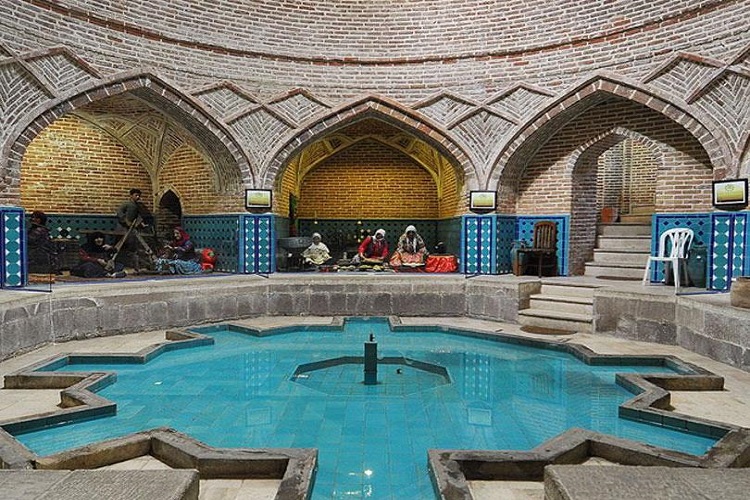
One of the oldest and largest baths in Qazvin, that was built by the order of Shah Abbas II, is called the “Royal Bath”. Qajar Bath
Because in the historical period, architects, due to the permanence of the date of construction, wrote it in code or in poetry, and by considering its abjad number, the date of construction has remained in the heart of the poem. This method makes the poem stay in the minds and if the inscription recorded in it is destroyed, the date of its creation is preserved.
Qajar Bath is located on Obaid Zakani Street next to the Bazaar and Agha Kabir Mosque and is the oldest bath in Qazvin. Which was built in 1057 AH by the order of Shah Abbas II Safavid by Amir Gooneh Khan, one of his commanders and commanders. The sights of Qazvin are so many that this city is the first city in terms of the number of tourist and historical attractions registered in Iran.
Qajar Bath is one of the oldest and largest baths in Qazvin, which was built in 1057 AH by Amir Goneh Khan, one of the emirs of Shah Abbas II in the Safavid period, in the current Obaid Zakani neighborhood, called the Royal Bath, that has 1045 square meters with three main sections: Sarbineh, Miander and Greenhouse. It has an area.
Qajar Bath architectural
The area of Qajar bath is about 1045 square meters and it consists of two separate parts for men and women and three main parts of Sarbineh, Miander and Greenhouse. The main door of the bathroom opens to the south and leads to the ceiling with a spiral staircase. The large sarbineh of the bath, in the middle of that there is a beautiful pool, connects the six royal residences and the arch in an octagonal plan with a corridor to the greenhouse. Sarbineh was a place to change clothes and prepare clients for bathing. There was another door to the bathroom from the west, that was probably for women.
Qajar Bath decorations include tiles and formal arches, and the floor is covered with marble. The roof of this bathroom is also level with the street.
Sarbineh, that has a rectangular design and consists of two truncated arches in the east and west, leads to the greenhouse through a corridor that has a very narrow truncated arch. The men’s and women’s greenhouses are in the shape of a cross and there are washing rooms in the east and west. The roof of the building is a dome and in each dome, the cupboard performs the act of lighting. The plinths of the greenhouses are tiled up to a height of 1.5 meters, and the formalization, Yazidi and roofing of the ceilings have added to its decoration. Large stones and one piece that pave the platforms are the features of Qajar Bath.
This historical monument was purchased by the Cultural Heritage and Tourism of Qazvin Province in 2000 and was restored with the investment of Qazvin Municipality and the management of the Renovation and Improvement Organization. Currently, this complex is considered as one of the tourist attractions of Qazvin province and is visited as an anthropological museum in 3 sections: ethnicities, customs and occupations.
The same museum consists of three sections of the Hall of Tribes, Occupations and Mirrors,tht are exhibited in the upper part of the life of the dominant tribes living in Qazvin, such as Tat, Maraghi, Kurd, Lor and Turk. The mourning of Imam Hussein (AS) and in the last part, six occupations of cupping, librarianship, barber shop, blacksmithing, taziyeh reading, prayer writing and batting are exposed to the visitors.
In this museum, we get to know more about the customs of the people of Qazvin.
It is narrated that the Ashura incident took place near the Bani Assad clan. After the martyrdom of Imam Hussein (AS) and his companions, Yazid did not allow the men of that tribe to bury the martyrs. Two days after the Ashura incident, the women of Bani Assad will bury the bodies of the martyrs. On this occasion, every year on the second day after Ashura, a group of women symbolically carry a symbolic corpse during a ceremony, holding a shovel and pickaxe, that is reminiscent of that event.
The Tat tribe is silent in the Buin Zahra and Takestan regions and earns a living through agriculture and horticulture, especially grape cultivation. After harvesting the grapes, they hang the clusters from the ceiling and keep the grapes healthy and fresh until the end of winter and Nowruz. This is called closing the door.
The Fifty Badr tradition is held every year in May in the prayer hall south of Qazvin. During this ceremony, Qazvin families settle by the Anbar water, pray for rain, and usually eat dimaj (traditional Qazvin food) and noodle soup, and distribute it among others. Finally, they go to the reservoir and press the small stones in their hands against the reservoir wall and make an intention. They believe that if their intention is fulfilled, the pebbles will stick to the body of the reservoir. The roots of this tradition are derived from the celebration of the creation of the sky.
The Kurds living in Qazvin province are located in the northwest of this province. In the past and in the Safavid period, they were forced to move to different parts of Iran, including this place, and Kurdish music has a special place among them.
Shirvareh is one of the oldest cooperatives. In the season when their milk supply is reduced, the females make their milk from the milk in a bowl in groups of several and give it to the members in turn and according to the amount brought so that each member can prepare enough dairy products. Slowly Shirvareh is common in almost all villages of Qazvin province.
The Turks are the largest ethnic group in the northern half of Iran. With the transfer of the capital from Tabriz to Qazvin by Shah Tahmasb Safavid in the middle of the tenth century AH, various tribes of this tribe migrated to the Qazvin region and are located in almost all parts, especially the central and western part of Qazvin province.
There are 17 villages in the Alamut region of Maragheh, that are very different in terms of race and language from other residents in the region. Maraghehs have unique skills in agriculture, especially in the cultivation of cereals, as well as in the production of clothing and textiles.
This harp, that was common in Qazvin in the ninth century AH (15th century AD), is one of the upright harps of the Islamic period, whose graphic design is more practical and beautiful than the harps of other regions.
Belief in openness in work, elimination of fear, cure of demons, cure of mental illnesses, etc., that is done by writing a prayer by a person called a prayer writer.